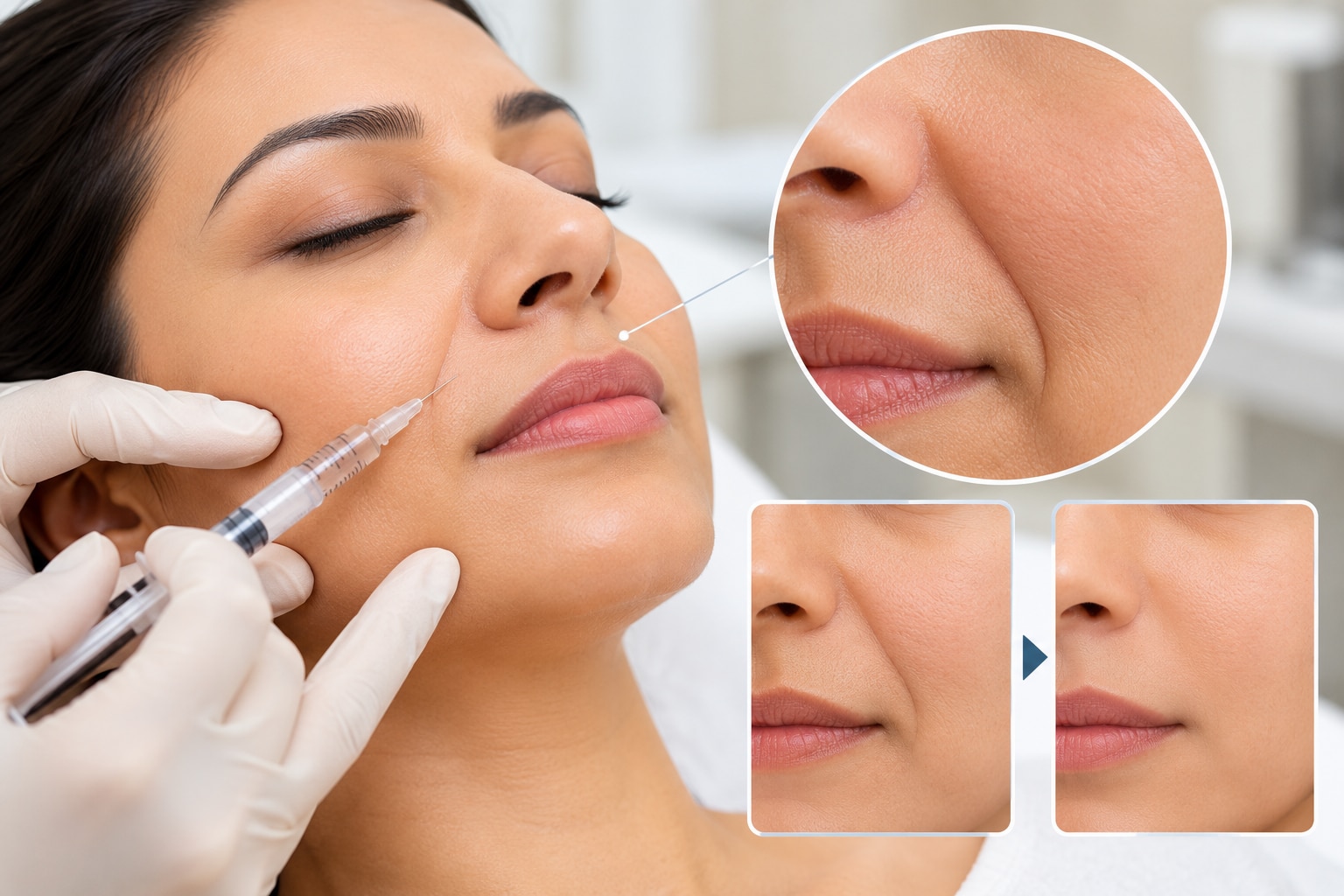
The most natural result depends on why the fold is visible: midface volume loss, cheek descent, skin laxity, facial movement, anatomy, or a combination of these causes. By comparing correction of the fold with cheek support, collagen stimulation, tightening, surgery, and no procedure, you can judge which option fits your face, expectations, downtime limits, and safety priorities.
Key takeaways
- Treat the cause of the fold, not only the visible crease.
- Conservative filler can soften smile lines without erasing facial movement.
- Compare downtime, duration, reversibility, and risks before treatment.
- Choose a Mumbai consultation with anatomical assessment and a conservative plan.
The Fold You See May Not Be the Problem That Needs Treating
The crease beside your nose is not always the structure that needs correction. Midface volume loss can reduce cheek support, while cheek descent, skin laxity, the nasolabial ligament, facial anatomy, and repeated smiling create different fold patterns.
Facial proportions also matter: a fold can look prominent because the cheek, lip, or lower face balances it differently.
A proper assessment examines the whole face, not just the deepest line:
- At rest, assess cheek support, tear troughs, marionette lines, lip position, skin quality, symmetry, and the relationship between the nose, cheek, mouth, and jaw.
- While smiling, observe how the cheek moves, whether the fold deepens from repeated movement, and whether direct treatment could alter expression or make the upper lip look heavy.
- Compare the overall face before choosing among nasolabial fold treatment options, then identify whether the main issue is volume, descent, laxity, anatomy, or movement.
Filling only the visible crease can create a ridge: it softens the shadow without restoring the surrounding contour. Cheek or midface support, sometimes with a small amount of direct filler, may produce better balance when descent or volume loss is responsible.
No procedure is the most natural choice when the fold is mild, normal for your anatomy, or unlikely to improve enough to justify cost, risk, swelling, and maintenance. Preserving facial movement and proportion can be a better result than erasing every millimetre.
Which Option Best Matches the Cause: Filler, Cheek Support, Tightening, or Surgery?
The most natural option depends on why the fold is visible. A mild-to-moderate crease without major descent often responds best to a small amount of hyaluronic-acid (HA) filler. If cheek volume loss or midface descent creates the shadow, restoring cheek support can look more balanced than filling the line alone.
| Option | Likely natural-looking benefit | Best match |
|---|---|---|
| HA filler | Precise, immediate volume; adjustable with hyaluronidase | Mild-to-moderate fold needing conservative softening |
| Cheek or midface support | Restores surrounding contour and reduces shadow | Volume loss or cheek descent |
| Calcium hydroxylapatite | Adds volume and stimulates collagen | Selected structural volume loss; not easily reversible |
| Poly-L-lactic acid | Gradual collagen-based improvement | Diffuse volume loss requiring staged treatment |
| Autologous fat grafting | Uses your own tissue for longer-term volume | Broader volume loss; survival and symmetry vary |
| Radiofrequency, ultrasound, laser, microneedling | Improves laxity, texture, or fine lines | Skin-quality concerns rather than a deep structural fold |
| Threads | Temporary lifting effect | Mild descent when variable longevity is acceptable |
| Facelift or midface lift | Addresses substantial descent and jowling | Significant laxity; greater recovery and surgical risk |
The nasolabial fold filler benefits include controlled placement, preserved facial movement, and the ability to stage correction. A small amount directly in the fold combined with cheek support can avoid the ridge, heaviness, or puffiness caused by treating the shadow in isolation.
Energy devices are not substitutes for volume restoration, and improvement may require several sessions. Threads offer lifting with variable longevity, while surgery involves anesthesia, incisions, recovery, scarring, bleeding, nerve injury, infection, and asymmetry risk. When the fold is mild or anatomically normal, no procedure can be the most natural choice.
Why Conservative Filler Often Looks More Natural Than Erasing the Line
Conservative filler looks more natural because it softens the fold instead of trying to erase it, preserving movement, expression, and facial proportion. The useful nasolabial fold filler benefits include reducing a shadow, restoring selected midface support, improving asymmetry, and avoiding a frozen expression.
A search for smile line correction in Mumbai should focus on balance, not a perfectly smooth crease.
Direct overfilling can create:
- Heaviness or puffiness beside the nose
- An overfilled upper-lip area
- A widened lower-face contour
- An unnatural smile
- A raised ridge that fills the crease but leaves the surrounding contour unsupported
A natural result uses small volume in the correct anatomical plane, a suitable hyaluronic-acid product, and an injector who understands facial vessels. The plan may place support in the cheek or midface, with only a small amount in the fold.
Staged correction is safer than adding a large volume at one visit: review the face after swelling and bruising settle, then decide whether more is needed.
HA filler is temporary; persistence varies with the product, movement, placement, and your tissues. It cannot remove excess skin or correct severe descent, and it will not permanently erase the fold. Maintenance is part of the decision.
If the main problem is laxity or descent, cheek support, tightening, surgery, or no procedure can look more natural than direct filler.
Compare Downtime, Duration, Reversibility, and Risk Before You Choose
The most controllable first choice is usually conservative HA filler, but the best result depends on the cause. Comparing nasolabial folds treatment options means weighing early swelling against the final result, not judging treatment in the mirror on day one.
| Option | Immediate and final result | Downtime, duration, reversibility |
|---|---|---|
| HA filler | Immediate softening; final assessment after swelling settles | Swelling, bruising, and tenderness for several days; staged treatment and maintenance; adjustable with hyaluronidase |
| Calcium hydroxylapatite or poly-L-lactic acid | Gradual collagen-related improvement; final effect develops over weeks or months | Often multiple sessions; maintenance required; not as readily reversible as HA |
| Threads | Early lift can be visible, while swelling and bruising settle | Pain, dimpling, or asymmetry can occur; longevity varies; removal does not equal easy reversal |
| Energy treatments | Gradual improvement in laxity, texture, or fine lines, not equivalent to structural volume | Several sessions may be needed; pigment change or scarring is possible, especially in darker skin types |
| Fat grafting | Immediate transfer with later change as swelling resolves; survival is variable | Bruising and recovery at two sites; fat is not predictably reversible; further grafting may be needed |
| Surgery | Immediate tightening, with final contours after substantial swelling resolves | Greatest pain, downtime, scarring, and operative risk; maintenance is usually longer-term but reversal is complex |
Nasolabial fold filler benefits include preserving movement when small amounts are placed in the correct plane. Ask who injects, the product and batch number, the injector’s knowledge of facial vessels, and the emergency protocol.
Severe or unusual pain, blanching, mottled skin, or visual symptoms after filler require urgent medical assessment. Botox is for diagnosed muscle-driven lines, not routine structural fold correction; near the mouth it can disrupt smiling, speech, or lip control.
How to Choose a Safe Consultation for Nasolabial Fold Correction in Mumbai
A search for the best nasolabial fold treatment in Mumbai should lead to a safety comparison, not a popularity contest. For nasolabial fold correction in Mumbai or smile line correction in Mumbai, check the injector’s relevant medical qualification, facial vascular anatomy experience, and willingness to recommend no procedure when improvement would be minor.
| Option | What to compare | When it may fit |
|---|---|---|
| HA filler | Named product, batch number, conservative plan, hyaluronidase access | Mild-to-moderate structural fold |
| Cheek support | Assessment of midface volume and descent | Shadow caused by reduced support |
| Tightening | Device, skin type risks, sessions and maintenance | Laxity or texture rather than deep volume loss |
| Threads or surgery | Longevity, recovery, scarring and irreversibility | Lift requirement beyond simple filling |
Before consenting, ask for:
- Before-and-after photographs showing the face resting and smiling, with comparable lighting and movement.
- The product name, expiry date, batch number, injection area and expected maintenance schedule.
- Written consent covering alternatives, swelling, bruising, vascular occlusion and urgent follow-up.
- A clear emergency arrangement for severe pain, blanching, mottled skin or visual symptoms.
A whole-face consultation matters. Dr. Akshay Kishor’s confidential practice illustrates why assessment should include cheek balance, lips, tear troughs, skin quality and facial movement before choosing an injection.
Conservative, anatomically planned HA filler is often the most controllable choice for a mild-to-moderate fold, but cheek support, tightening, surgery, or no procedure can be more natural when the cause differs.
Related service
Cosmetology All types of Nasolabial folds treated Fillers / Threads / Combination View service → |
Frequently asked questions
What can cause prominent nasolabial folds?
Midface volume loss, cheek descent, skin laxity, the nasolabial ligament, facial anatomy, and repeated smiling can all contribute. The visible fold is not always the structure that needs treatment.
Which nasolabial fold treatment matches each cause?
Filler may suit selected volume loss; cheek support can address reduced midface support; tightening targets laxity; and surgery is considered when descent and excess skin require a more extensive correction.
Why can conservative filler look more natural?
A conservative amount softens the transition around the fold while preserving facial movement. Trying to erase the line completely can create heaviness or an overfilled appearance.
What should you compare before choosing nasolabial fold correction?
Compare downtime, expected duration, reversibility, treatment extent, and risks. Ask how the plan addresses your anatomy rather than treating every visible line in the same way.
Keywords