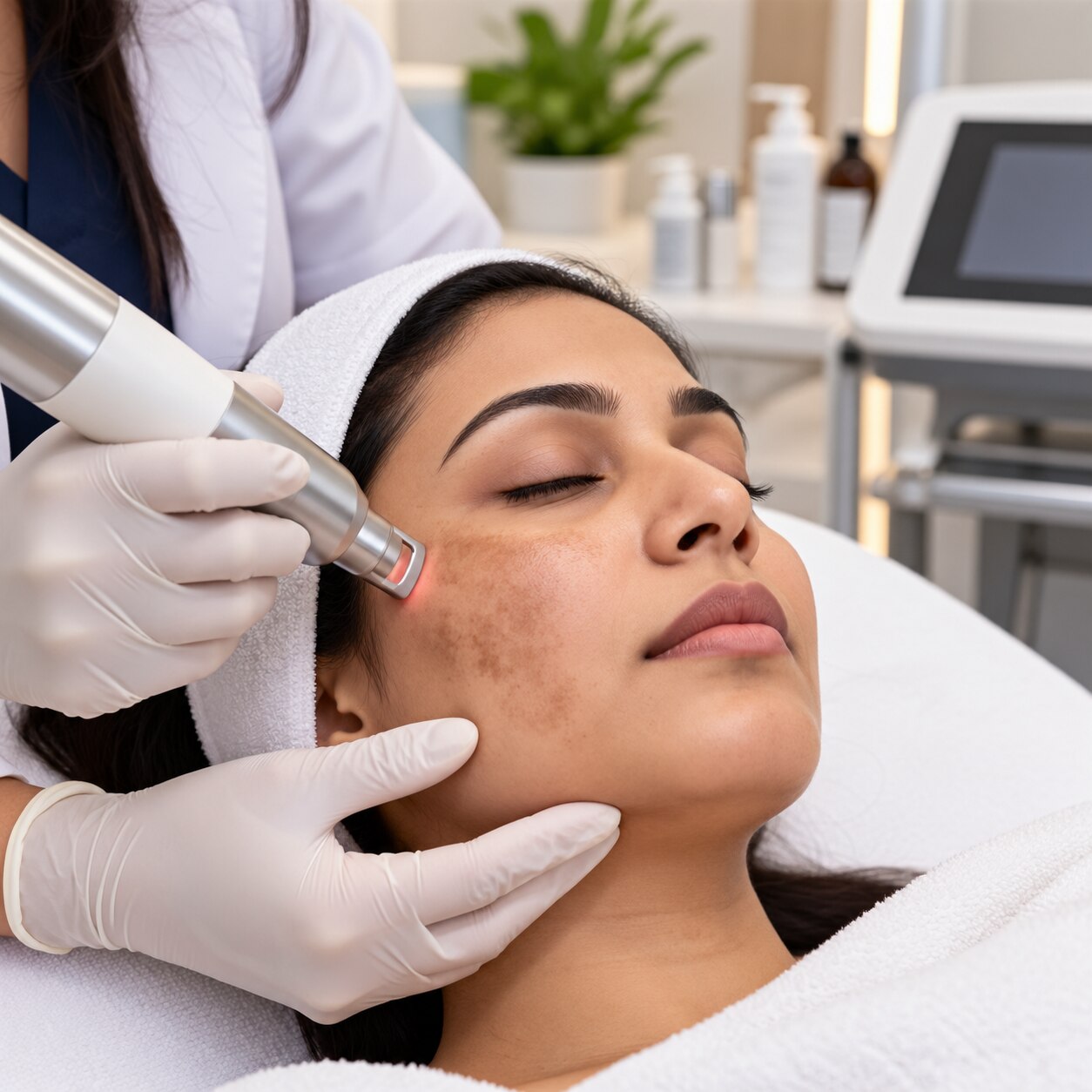
Dark facial patches do not all respond to the same treatment, and choosing the wrong cream or procedure can worsen irritation and pigmentation. By the end, you will know which signs help distinguish melasma from similar conditions, what a dermatologist checks, and how skin sensitivity, pigment depth, pregnancy status, and Mumbai exposure affect your treatment plan.
Key takeaways
- Confirm melasma before treating; several conditions cause similar brown or grey patches.
- Choose creams or tablets only after reviewing pregnancy, medicines, hormones, and medical history.
- Use peels, microneedling, lasers, or IPL selectively; irritation can worsen pigmentation.
- Wear broad-spectrum SPF 50 sunscreen daily and schedule follow-up to prevent relapse.
Is the pigmentation really melasma?
Melasma is more likely when flat, fairly symmetrical brown or grey patches appear on both cheeks, the forehead, nose, upper lip, or jawline without scaling or a rash. A dermatologist must still exclude post-inflammatory hyperpigmentation, sun spots, freckles, contact reactions, drug-induced pigmentation, lichen planus pigmentosus, and ochronosis before selecting treatment.
| Cause | Clues that separate it from melasma | Useful next step |
|---|---|---|
| Melasma | Symmetrical centrofacial, malar, or mandibular patches; worsens with sunlight or visible light | Clinical examination |
| Post-inflammatory hyperpigmentation | Follows acne, eczema, burns, waxing, or irritation; matches the earlier inflammation | Treat the trigger first |
| Sun spots or freckles | Individual sharply defined spots, often on chronically sun-exposed skin; freckles darken seasonally | Assess distribution and history |
| Contact or drug pigmentation | Burning, itching, new cosmetics, hair dye, perfume, or medication precedes the colour change | Stop the suspected trigger and review medicines |
| Lichen planus pigmentosus or ochronosis | Slate-grey or blue-brown colour, unusual borders, or gradual spread despite standard care | Specialist assessment; biopsy if atypical |
Your history matters. Report pregnancy, oral contraceptives, hormone therapy, thyroid disease, new medicines, cosmetics, acne, waxing, sun exposure, and time spent in bright daylight because visible light can deepen melasma. A Wood’s lamp or dermoscopy can map epidermal versus dermal pigment; mixed or dermal pigment often responds more slowly.
Biopsy is reserved for uncertain or unusual cases. Avoid aggressive melasma treatment options in Mumbai until the diagnosis is secure, because irritation can worsen pigmentation.
How do pattern, history, and pigment depth change the diagnosis?
A melasma doctor in Mumbai confirms the diagnosis by matching your facial pattern with your history and the behaviour of pigment during examination. The three patterns are centrofacial, affecting the forehead, nose, cheeks, upper lip and chin; malar, affecting the cheeks and nose; and mandibular, affecting the jawline.
Distribution supports melasma but does not prove pigment depth.
- Facial pattern: Note whether colour is symmetrical and patchy rather than confined to a scar, rash, or single sun spot.
- Timing and triggers: Ask about pregnancy, oral contraceptives, hormone therapy, thyroid disease, new medicines, cosmetics, sun exposure, and visible-light exposure.
- Skin surface: Look for preceding acne, eczema, burning, or irritation that suggests post-inflammatory pigmentation or a contact reaction.
- Pigment mapping: Use dermoscopy to assess colour and structure. A Wood’s lamp can make epidermal pigment more apparent, while dermal pigment shows little change; mixed pigment shows both patterns.
Superficial, epidermal pigment often responds more predictably to topical treatment. Deep, dermal pigment usually fades more slowly, while mixed pigment can require longer control and has a greater chance of incomplete improvement. A biopsy is reserved for an atypical or uncertain presentation, such as unusual texture, one-sided pigmentation, or rapid change.
A proper assessment therefore sets expectations in months, not a fixed number of sessions.
Which creams and oral treatments suit your skin and medical history?
Choose the least irritating treatment that can control your pigment, not automatically the strongest option. Skin sensitivity, pregnancy status, hormonal medicines, pigment severity, and your ability to maintain sun and visible-light protection determine the safer choice.
| Option | Best fit | Important cautions |
|---|---|---|
| Prescription triple cream | Moderate-to-severe melasma needing faster control | Hydroquinone, a retinoid, and a corticosteroid can cause irritation, acneiform eruptions, steroid side effects, or ochronosis when used too long; use only for a dermatologist-defined period. |
| Non-hydroquinone creams | Sensitive skin, maintenance, or hydroquinone intolerance | Azelaic acid, cysteamine, kojic acid, topical tranexamic acid, and retinoids are not interchangeable. Retinoids are avoided during pregnancy; discuss azelaic acid or another suitable option with your doctors. |
| Oral tranexamic acid | Resistant or recurrent melasma after topical treatment is inadequate | This is an off-label medicine, not a beauty supplement. A melasma specialist in Mumbai should review clotting history, migraine and thromboembolic risk, and hormonal medicines, especially combined contraceptives. |
Pregnancy changes the decision: do not self-start hydroquinone, topical retinoids, or oral tranexamic acid. Ask your obstetrician and dermatologist to select a pregnancy-compatible plan. Hormonal contraception, thyroid disease, or hormone therapy also belongs in the treatment history because recurrence can follow ongoing triggers.
Expect maintenance rather than permanent clearing. Once colour improves, stopping treatment and skipping protection increases recurrence risk, especially with mixed or deeper pigment.
When do peels, microneedling, lasers, or IPL make sense?
Do not start with a peel or laser simply because the patches look darker. Procedures make sense after melasma is confirmed, daily photoprotection is consistent, and a suitable topical plan has been given enough time to work; they are usually adjuncts or second-line options.
- Chemical peels: Consider a dermatologist-selected, superficial peel for persistent epidermal pigment. Strong acids, frequent sessions, or home peeling can burn Indian skin and trigger darker post-inflammatory pigmentation.
- Microneedling: Use only when the skin barrier is calm and the clinician has a clear plan for needle depth and aftercare. Excessive passes, bleeding, or applying irritating products through fresh channels increases inflammation.
- Pigment lasers: Reserve them for selected, treatment-resistant cases after discussing recurrence and pigment depth. High fluence or repeated passes can worsen dermal or mixed melasma rather than remove it.
- IPL: Consider it only for carefully selected, predominantly superficial pigment with minimal active irritation. It is not automatically safer than a laser for brown skin.
Reduce risk by choosing conservative settings, requesting a test spot when appropriate, and avoiding treatment over sunburn, dermatitis, active acne, or recently irritated skin. Do not combine procedures with scrubs, retinoids, bleaching products, or multiple acids unless instructed.
Afterward, use broad-spectrum SPF 30 or higher, reapply during outdoor exposure, and consider tinted sunscreen containing iron oxides for visible-light protection. A melasma treatment clinic in Mumbai should discuss months, not days, and should not promise permanent clearing or a fixed number of sessions.
What daily protection and follow-up plan will keep melasma controlled?
Use sunscreen every morning, even on cloudy Mumbai days or when you spend the day near windows. Choose broad-spectrum SPF 30 or higher; a tinted formula containing iron oxides adds protection against visible light, which can deepen melasma in Indian skin.
- Apply roughly two finger-lengths of sunscreen to your face and neck.
- Reapply every two hours during outdoor exposure, and after sweating or wiping your face.
- Add a wide-brimmed hat, sunglasses, shade, and an umbrella for midday travel.
Maintenance treatment usually begins after the initial lightening phase. Your dermatologist may reduce the frequency of a prescription cream or switch you to a gentler long-term option. Do not extend hydroquinone or a steroid-containing combination without review; irritation, acne-like eruptions, steroid effects, and ochronosis can follow unsupervised use.
A proper melasma consultation in Mumbai should include your pregnancy status, medicines, hormone history, skincare products, sun exposure, and prior reactions. Expect baseline photographs, an examination of pigment depth, clear instructions for application, and review dates rather than a promise of permanent clearing or a fixed number of laser sessions.
Ask what improvement is realistic over several weeks to months and what to do if burning or peeling starts. Dr. Akshay Kishor should be able to explain why the chosen maintenance plan fits your skin sensitivity, recurrence risk, and daily routine.
Stop layering scrubs, acids, bleaching products, and retinoids unless prescribed together; inflammation can make the patches darker.
Related service
Dermatology All types and severity of melasma treated Best medicines and procedures View service → |
Frequently asked questions
How can you tell whether facial pigmentation is melasma?
Melasma usually causes flat, symmetrical brown or grey patches on the cheeks, forehead, nose, upper lip, or jawline without scaling. A dermatologist must exclude post-inflammatory hyperpigmentation, sun spots, freckles, contact reactions, drug-induced pigmentation, lichen planus pigmentosus, and ochronosis.
How do pattern, history, and pigment depth affect melasma treatment?
A dermatologist assesses the distribution, colour, duration, triggers, hormonal history, medicines, skin sensitivity, and pigment depth. These findings help distinguish epidermal, dermal, and mixed pigmentation and guide treatment intensity.
Which melasma creams or oral treatments may be suitable?
Treatment depends on your diagnosis, skin sensitivity, pregnancy or breastfeeding status, medical conditions, and current medicines. A dermatologist may consider prescription lightening combinations, azelaic acid, retinoids, or oral therapy when appropriate, with monitoring for irritation and side effects.
When do peels, microneedling, lasers, or IPL make sense?
Procedures are considered when diagnosis is secure, daily sun protection is consistent, and topical treatment has not provided enough improvement. They require careful settings and aftercare because inflammation can trigger darker pigmentation, especially in Indian skin.
How do you keep melasma controlled after treatment?
Apply broad-spectrum SPF 50 sunscreen every morning, reapply during outdoor exposure, use shade and a hat, avoid irritating products, and attend planned follow-ups. Maintenance treatment is often needed because melasma can return.
Keywords